From First Conversation to Finished Website: Our Process
More Than a Website: Building a Foundation for Growth
For many business owners, investing in a new website or marketing strategy can feel like a big decision.
There are countless options available, plenty of opinions online, and often a lot of uncertainty about what the process actually looks like. Questions like "Where do we start?" or "How do we know this will work?" are completely normal.
The truth is, successful websites aren't built because someone picked the right color palette or installed the latest technology. They're built through a thoughtful process that starts with understanding a business, its customers, and its goals.
At NEKO, we believe a website should be more than a digital brochure. It should be a tool that strengthens customer relationships, supports marketing efforts, and creates opportunities for growth.
That's why our process doesn't begin with design; it begins with listening.
Before we make recommendations, create layouts, or discuss functionality, we take the time to understand the business behind the website. We want to know what makes your company unique, what challenges you're facing, and what success looks like from your perspective.
From there, we take every step to build a stronger online presence that supports your business goals.
The truth is, in today's digital landscape, a website isn't operating alone. Your website, search visibility, reviews, business listings, social media presence, advertising efforts, and analytics all influence how potential customers find, evaluate, and interact with your business.
When those pieces work together, marketing becomes more effective. When they're disconnected, opportunities are often missed.
Our goal is to help businesses create a connected system that not only looks professional but also produces measurable results.
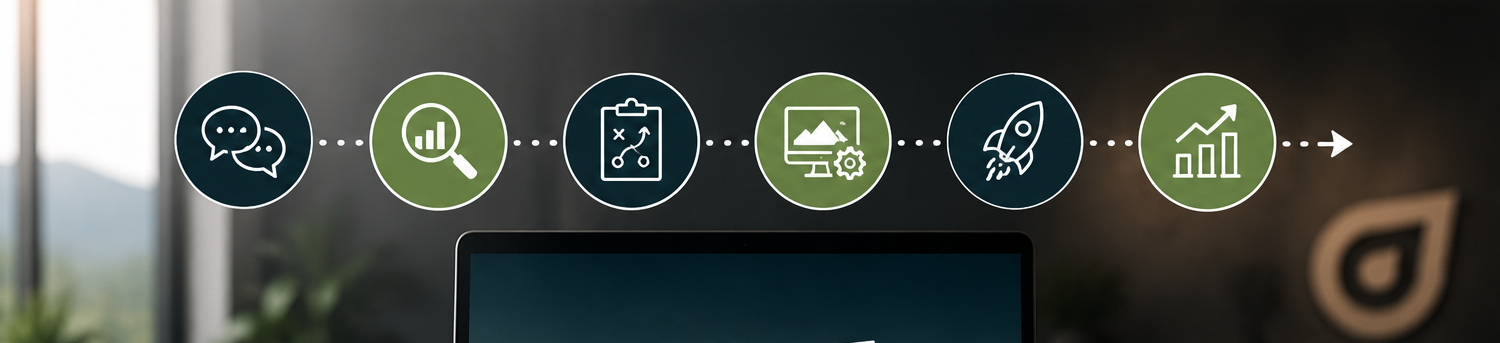
Here's what that process looks like.
Step 1: The First Conversation
Every project begins with a conversation. Not a sales pitch. Not a design review. A conversation.
Before discussing layouts, colors, or functionality, we focus on understanding the business itself. We want to learn how your company operates, what challenges you're facing, and where you want to go.
We ask questions about your customers, your goals, your current marketing efforts, and what success looks like for your organization.
This stage is critical because every business is different.
What works for a local contractor may not work for an e-commerce retailer. What works for a professional service provider may not work for a tourism business. Understanding those differences allows us to develop recommendations that are aligned with your specific goals instead of relying on assumptions.
Strong marketing starts with understanding.
Step 2: Discovery & Insights
Once we understand your goals, the next step is understanding your current digital landscape.
Many businesses are surprised by how interconnected their online presence has become. A customer may discover your business through a Google search, check your reviews, browse your social media pages, visit your website, and compare you to competitors before ever reaching out.
That's why we evaluate more than just the website itself.
During discovery, we review key areas such as:
- Website performance
- SEO visibility
- Business listings
- Online reviews
- Social media presence
- Advertising performance
- Analytics and reporting
- Mobile usability
- Conversion opportunities
- E-commerce functionality
We're looking for strengths, weaknesses, opportunities, and gaps.
In many cases, we uncover issues that business owners aren't even aware of. Listings may be inconsistent across platforms. Reviews may not be leveraged effectively. Advertising may be generating traffic, but not conversions. Analytics may not be properly tracking important actions.
These insights help us identify where opportunities exist and create a roadmap for improvement.
Because before you can improve performance, you need to understand what's happening today.
Step 3: Strategy Development
One of the biggest misconceptions in our industry is that web design starts with design. In reality, the most successful websites begin with a strategy.
Without a clear understanding of your audience, messaging, and business objectives, even the most visually impressive website can struggle to generate results.
This phase focuses on creating a plan.
We evaluate:
- Audience targeting
- Customer journeys
- Website structure
- Calls-to-action
- Conversion opportunities
- Search visibility
- Content organization
- User experience
- Messaging clarity
Every recommendation is tied back to a business goal.
The objective isn't simply to create a website that looks good. The objective is to create a website that helps move visitors through a decision-making process and encourages meaningful action.
A strong strategy creates clarity for both the business and the customer.
Step 4: Building the Website Experience
Once the strategy is established, we begin building the website experience.
At this stage, the focus shifts toward bringing the strategy to life through thoughtful design, content, and functionality.
Every section of the website should serve a purpose.
That may include:
- Homepage messaging
- Service pages
- Product pages
- E-commerce functionality
- Testimonials and reviews
- FAQ sections
- Contact opportunities
- Social integrations
- Conversion-focused calls-to-action
One concept we often discuss is website sections.
Visitors don't read websites the way they read books. They scan. They look for information quickly and make decisions rapidly.
Well-structured website sections help guide visitors naturally through the information they need to make a decision.
Clear headlines, strategic content placement, trust-building elements, and intuitive navigation all contribute to a better user experience.
The goal is simple: Help visitors understand who you are, what you do, why it matters, and what they should do next.
Step 5: Refinement & Collaboration
No successful website is built in isolation.
Throughout the process, we work closely with our clients to refine messaging, review content, test functionality, and ensure the final product aligns with their goals. This collaborative phase is often where some of the most valuable improvements occur.
- Small adjustments to messaging can improve clarity.
- Changes to page structure can improve conversions.
- Updates to navigation can improve user experience.
- Minor refinements often create major results.
Because successful websites are rarely the result of one big decision.
They're usually the result of many thoughtful decisions working together.
Step 6: SEO, Listings, Reviews & Visibility Optimization
A website can only create opportunities if people can find it. That's why visibility plays such an important role in our process.
Search engines, AI-powered search tools, business listings, reviews, and local directories all influence how businesses appear online.
We focus on areas such as:
- Search Engine Optimization (SEO)
- Answer Engine Optimization (AEO)
- Business listings
- Google Business Profile optimization
- Review management
- Local search visibility
- Search-friendly content structure
- FAQ development
- Analytics tracking
Search behavior continues to evolve.
Today, consumers aren't just typing keywords into search engines. They're asking complete questions through AI tools and conversational search platforms.
Businesses that provide clear answers and useful information are often better positioned to appear in these emerging search experiences.
That's why visibility is no longer just about rankings; It's about being present wherever customers are looking.
Step 7: Ongoing Improvements & Long-Term Growth
Perhaps the most important thing we tell clients is this: Launch day isn't the finish line.
It's the beginning.
Digital marketing is not a one-time project.
Customer behavior changes. Search engines evolve. AI-powered search continues to grow. Competitors adapt. New opportunities emerge.
The businesses that see the strongest long-term results are often the ones that continue evaluating and improving their digital presence over time.
That's why our work doesn't stop after a website launches.
We continue monitoring:
- Analytics
- Search visibility
- Conversion performance
- Content effectiveness
- Advertising results
- User behavior
- Lead generation opportunities
The data helps us make informed decisions and identify opportunities for improvement.
Because marketing should never be based on guesses, it should be based on real information.
Why Our Process Matters
At the end of the day, our process at Northeast Kingdom Online is designed around one simple goal: Helping businesses create stronger relationships with their customers.
A website is only one piece of that equation.
When websites, reviews, listings, SEO, advertising, social media, analytics, and customer experience work together, businesses create more opportunities to connect with the right audience.
Those connections build trust.
Trust creates conversations.
Conversations create customers.
And customers create growth.
That's why we focus on more than websites. We focus on building systems that help businesses grow with confidence.
Frequently Asked Questions